Setscrew holding power lookup
You are fixing a collar, pulley or gear to a shaft with a socket set screw and need to know what one screw holds, in thrust and in torque, how hard to seat it, and how much margin to keep. Pick the screw size and the point style, and type the shaft diameter if you know it. The tool looks up that one screw and works the rest out. It loads with a worked example filled in.
More calculators in the Toolbox
What holding power means
Holding power is the load at which the shaft and the collar first move 0.010 in against each other, measured by the maker on a steel shaft with the screw seated at a stated torque. It is a test result for one maker's alloy steel screws, not a guarantee, and it is the axial load along the shaft. Worked example: a 1/4 cup-point screw, seated at 87 in·lb, holds 1000 lb (4448 N) of thrust.
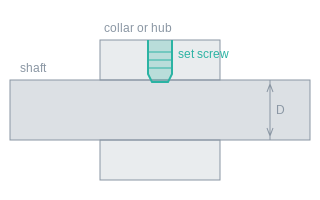
Torque a set screw holds on a shaft
The torque the joint holds is the axial holding power times half the shaft diameter: T = Fa × D / 2. Worked example: the same screw on a 0.500 in shaft holds 1000 × 0.500 / 2 = 250 in·lb (28 N·m). The tool prints every figure rounded down, so it never shows more than the maker's guide does. A screw about half the shaft diameter is the source's rule of thumb. The tool gives the ratio and does not judge it.
Point style and shaft hardness
The source's figures are for a cup-point screw. A cone point holds about 7% more, a flat or half-dog point about 8% less and an oval point 10% less, and the tool applies those factors to the axial value. Worked example: a #10 cone-point screw holds 540 × 1.07 = 577 lb, and on a 3/16 in shaft 54 in·lb. The shaft matters as much as the point: keep it at least 10 points Rockwell C softer than the screw, about Rc 50. With less difference, the source says up to 15% of the holding power can be lost. A second screw does not double the holding power, and the tool does not compute it.
Safety factors for static and moving loads
The source gives a range of safety factors: 1.5 to 2.0 for a static load and 4.0 to 8.0 for a moving one. The tool shows the working range from both ends and picks no single factor. In the first example a static load gives a working torque of 125 to 166 in·lb and a working thrust of 500 to 666 lb. Type the torque or the thrust the joint must carry and the tool says what factor one screw gives and whether that is below, inside or above the range. It does not say pass or fail.
Putting a set screw on a drawing
The joint appears on two drawings. On the collar or hub drawing, the tapped hole goes through the hub wall into the bore: 1/4-20 UNC-2B THRU, located from the hub face to the hole axis, on the bore's centre plane. If the screw must land on a flat on the shaft, the angular position goes on the assembly, not the collar. On the assembly drawing, the screw is a purchased part on the parts list, such as SOCKET SET SCREW, CUP POINT, 1/4-20 UNC-3A x 5/16, ALLOY STEEL, ASME B18.3, with the note SEAT SET SCREW AT 87 IN-LB. 5/16 is the shortest length the source lists for this size. A flat on the shaft under the screw keeps the burr from the point off the surface a collar slides over, and gives the screw a seat. Dimension the flat's depth and length on the shaft drawing. The thread callout builder writes the thread note for the tapped hole, the fastener hole tool gives the drill and the clearance, and the bolt torque calculator is for screws that clamp rather than lock. For a shaft that needs a groove for a retaining ring instead, see the retaining ring groove lookup, and for sizing the shaft itself the shaft diameter calculator.
Holding power, seating torque and factors are Unbrako's published test data for their alloy steel socket set screws (Unbrako Engineering Guide), for the one size picked.
These are one maker's typical figures for standard alloy steel socket set screws, not guaranteed values. The holding power is the load at which the parts first slip, measured on a steel shaft of ordinary hardness with the screw seated at the stated torque. Vibration, a hard or soft shaft, a loose thread fit, lubricant and reuse all change it. The tool doesn't check the shaft, the collar or the thread for strength. Where a part coming loose could hurt someone, use a positive drive such as a key or pin and have the joint checked by a qualified engineer.
Rapid Datum makes the drawing from your STEP file, tapped holes and their thread callouts included. First drawing free, watermarked.
Questions
How much torque can a set screw hold?
It depends on the screw size and the shaft diameter. For a 1/4 cup-point screw on a 0.500 in shaft it is 250 in·lb, from the maker's test data named on this page.
How tight should a set screw be?
The maker gives a seating torque for each size, 87 in·lb for a 1/4 alloy steel screw. The tool shows it for the size you pick.
Can I use two set screws?
Yes, but a second screw does not double the holding power. How much it adds depends on the angle between the screws; see the maker's guide.