O-ring groove calculator
You are sealing a piston, a rod or a flat joint with a standard inch O-ring and need the groove to cut: its depth, its width, its corner radius, the clearance gap allowed, and how much the ring is squeezed. Pick the seal type and the ring's cross-section, or type its AS568 dash number, and the tool looks up that one gland. Type the bore or rod diameter as limits and it works out the groove and piston diameters to put on the drawing. It loads with a worked example filled in.
More calculators in the Toolbox
Gland depth, groove width and squeeze
The gland is the groove and the two surfaces that close it. The ring's cross-section W is a little more than the gland depth L, so the ring is squeezed when the parts are assembled. The groove width G is wider than W so the squeezed ring has room to spread. R is the radius in the corners of the groove, and E is the diametral clearance between the piston and the bore, or the rod and the housing, which the ring must bridge without being pushed into it. The squeeze is W less L: the tool prints the chart's own range in inches and in percent.
Piston and rod seals (radial glands)
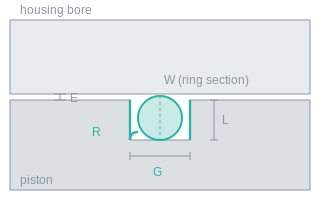
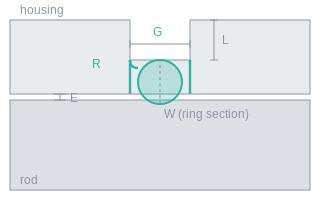
A piston seal has its groove in the piston and the ring squeezed against the bore. A rod seal has its groove in the housing and the ring squeezed against the rod. Static radial means the two parts do not slide on each other. Reciprocating means they do, and the ring is squeezed less. Worked example, static radial, piston seal, 1/8 in cross-section (W .139 ± .004), bore 2.000, no back-up ring: the gland depth is .111 to .113, the groove width .187 to .192, the corner radius .010 to .025, the clearance .003 to .006 and the squeeze .022 to .032 in, 16 to 23%. The groove diameter is 1.774 to 1.778 and the piston diameter 1.994 to 1.997. The callouts are Ø1.774-1.778, .187-.192, R.010-.025 and Ø1.994-1.997. In mm the groove diameter is 45.06 to 45.16 and the groove width 4.75 to 4.87.
For a rod seal the tool mirrors the sums: the groove diameter is the rod diameter plus twice the gland depth, and the housing bore beside the groove is the rod diameter plus the clearance. Worked example, reciprocating, rod seal, 1/8 in cross-section, rod 1.000: the gland depth is .121 to .123, the squeeze .012 to .022 in, 9 to 16%, the groove diameter 1.242 to 1.246 and the housing bore beside the groove 1.003 to 1.006.
Face seals
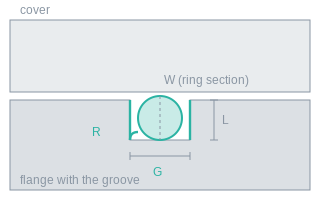
A face seal sits in a groove cut in a flat face and is squeezed by the part bolted against it. It can take more squeeze than a sliding seal, up to 30%. The groove width depends on the fluid: a liquid gets a wider groove than a vacuum or a gas. The groove diameter comes from the ring's inside diameter, which you read from your ring supplier's listing: for pressure from the inside the groove's outside diameter is the ring's inside diameter plus twice the ring's cross-section, with a tolerance of minus 1% (at most .060 in); for pressure from the outside the groove's inside diameter is the ring's inside diameter, with plus 1%. Worked example, static face, 1/8 in cross-section, liquid, pressure from inside, ring inside diameter 1.984: the gland depth is .101 to .107, the groove width .177 to .187, the corner radius .010 to .025 and the squeeze .028 to .042 in, 20 to 30%. The groove outside diameter is 2.262 +.000 / −.022. For vacuum and gases the groove width is .158 to .164.
Stretch, gland fill and back-up rings
The ring should fill 60 to 85% of the gland, with about 75% as the aim and at least 10% left empty for swell and heat. The tool states this and does not compute the fill. A piston seal ring is stretched over the piston, and more than 5% stretch is not advised. Type the ring's inside diameter from your ring supplier's listing and the tool gives the stretch from the groove diameter. Back-up rings sit beside the ring on its low-pressure side to stop it being pushed into the clearance. A radial gland with one back-up ring needs a wider groove, and one with two wider still: in the piston seal example above the groove width is .187 to .192 with none, .208 to .213 with one and .275 to .280 with two.
Putting an O-ring groove on a drawing
Dimension the groove as geometry, as limits: its diameter, its width, its corner radius, and its position from the face. Put them on the drawing as limits, not as nominal plus or minus a tolerance, the way the chart prints them. The tool's copy buttons give each one in the form Rapid Datum prints it, as an inch set or an mm set, never mixed. For a static seal add a surface finish note for the groove sides and bottom; see the surface finish converter for how a finish is written. For a sliding seal the tool gives two finish notes: one for the grooved part (groove bottom and sides, the sides a little rougher with a back-up ring), and one for the surface the ring slides on, which goes on the drawing of the rod, or of the cylinder for a piston seal, not on the grooved part. A groove for a retaining ring is a different groove, in the retaining ring groove lookup. The bore or rod the groove depends on can be given a fit class in the inch fit calculator, and the holes in the flange that holds a face seal are in the fastener hole tool.
Gland dimensions from the Parker O-Ring Handbook (ORD 5700), for the one cross-section and seal type picked.
Gland dimensions for standard inch O-rings from one maker's handbook, for general industrial sealing. The tool gives the groove for the cross-section and seal type picked. It doesn't choose the ring material or hardness, and it doesn't check pressure, temperature, fluid, extrusion or speed. The bore or rod must be held to the limits you typed; the groove limits depend on them. Sliding seals depend on finish and lubrication as much as on the groove. Other makers and aerospace standards give different glands. Where a leak could hurt someone or the environment, the seal is checked by a qualified engineer against the ring maker's current data.
Rapid Datum turns your STEP file into a dimensioned drawing, grooves included: it draws the groove you modelled, so size it here first. First drawing free, watermarked.
Questions
How deep is an O-ring groove?
It depends on the ring's cross-section and whether the seal slides. For a static radial seal on a 1/8 in cross-section ring the gland depth is .111 to .113 in, from the handbook chart named on this page.
How much should an O-ring be squeezed?
A static seal is squeezed more than a sliding one. The tool prints the chart's range for the section and seal type you pick, in inches and in percent.
Does the tool choose the ring?
No. It gives the groove for the cross-section and seal type you pick. The ring's material, hardness and inside diameter come from your ring supplier.