Stress concentration factor lookup
You are sizing a shaft or a plate and need the theoretical stress concentration factor Kt at a shoulder or a hole, with the nominal stress it multiplies stated beside it. Pick the case, enter the sizes, and read Kt. Add a load to get the stresses. It loads with a worked example filled in.
More calculators in the Toolbox
What Kt is, and what it multiplies
Kt is the ratio of the peak stress at a shoulder or a hole to the nominal stress there, in elastic material. The nominal stress is the stress you would calculate if the feature were not there: on the small diameter of a shaft, 32 M / (π d³) in bending, 4 P / (π d²) in tension and 16 T / (π d³) in torsion, and on the net section of a plate, P / ((D − d) t). Kt multiplies that nominal stress, and only that one. The tool computes the peak stress from the unrounded Kt.
Shoulder fillet on a stepped shaft
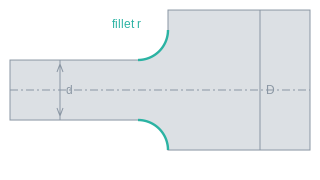
With h = (D − d) / 2, Kt = C1 + C2 (2h / D) + C3 (2h / D)² + C4 (2h / D)³, where each C = a + b √(h / r) + c (h / r). The coefficients (a, b, c) are the set printed by AmesWeb, Mechanical Geek and Jönköping University's applied mechanics notes (bending and torsion), and by AmesWeb and Mechanical Geek (tension):
| Loading and range | C1 (a, b, c) | C2 | C3 | C4 |
|---|---|---|---|---|
| Bending, 0.1 ≤ h/r ≤ 2.0 | (0.947, 1.206, −0.131) | (0.022, −3.405, 0.915) | (0.869, 1.777, −0.555) | (−0.810, 0.422, −0.260) |
| Bending, 2.0 < h/r ≤ 20 | (1.232, 0.832, −0.008) | (−3.813, 0.968, −0.260) | (7.423, −4.868, 0.869) | (−3.839, 3.070, −0.600) |
| Tension, 0.1 ≤ h/r ≤ 2.0 | (0.926, 1.157, −0.099) | (0.012, −3.036, 0.961) | (−0.302, 3.977, −1.744) | (0.365, −2.098, 0.878) |
| Tension, 2.0 < h/r ≤ 20 | (1.200, 0.860, −0.022) | (−1.805, −0.346, −0.038) | (2.198, −0.486, 0.165) | (−0.593, −0.028, −0.106) |
| Torsion, 0.25 ≤ h/r ≤ 4.0 | (0.905, 0.783, −0.075) | (−0.437, −1.969, 0.553) | (1.557, 1.073, −0.578) | (−1.061, 0.171, 0.086) |
At exactly h / r = 2.0 the lower set is used. The tool covers D / d from 1.02 to 2.0 and refuses outside the range of each fit; it never extrapolates. Worked example: D 30, d 20, r 3 in bending, so h = 5, h / r = 1.67 and 2h / D = 0.333. Kt = 1.56. With a moment of 100 N·m the nominal stress is 127.3 MPa and the peak stress is 198.5 MPa. In bending between h / r 0.25 and 2.0, a second published fit (ASEE conference paper, 2025) is shown as a comparison and gives 1.55 here.
U-groove on a shaft
With h = (D − d) / 2, where d is the diameter at the bottom of the groove and r the radius at the bottom, the form is the same as for the shoulder: Kt = C1 + C2 (2h / D) + C3 (2h / D)² + C4 (2h / D)³, each C = a + b √(h / r) + c (h / r). The coefficients are the set printed by AmesWeb and Jönköping University's applied mechanics notes (bending and torsion):
| Loading and range | C1 (a, b, c) | C2 | C3 | C4 |
|---|---|---|---|---|
| Bending, 0.25 ≤ h/r ≤ 2.0 | (0.594, 2.958, −0.520) | (0.422, −10.545, 2.692) | (0.501, 14.375, −4.486) | (−0.613, −6.573, 2.177) |
| Bending, 2.0 < h/r ≤ 50 | (0.965, 1.926, 0) | (−2.773, −4.414, −0.017) | (4.785, 4.681, 0.096) | (−1.995, −2.241, −0.074) |
| Torsion, 0.25 ≤ h/r ≤ 2.0 | (0.966, 1.056, −0.022) | (−0.192, −4.037, 0.674) | (0.808, 5.321, −1.231) | (−0.567, −2.364, 0.566) |
| Torsion, 2.0 < h/r ≤ 50 | (1.089, 0.924, 0.018) | (−1.504, −2.141, −0.047) | (2.486, 2.289, 0.091) | (−1.056, −1.104, −0.059) |
At exactly h / r = 2.0 the lower set is used. The nominal stress is on the diameter at the bottom of the groove: 32 M / (π d³) in bending and 16 T / (π d³) in torsion. Tension at a groove is not offered. Worked example: D 24, d 20, r 1, so h = 2, h / r = 2.0 and 2h / D = 0.167. In bending Kt = 2.52, and with a moment of 100 N·m the nominal stress is 127.3 MPa and the peak stress is 321.3 MPa. In torsion Kt = 1.81, and with a torque of 150 N·m the nominal stress is 95.5 MPa and the peak stress is 172.5 MPa. The radius at the bottom of the groove sets Kt. On the drawing, give it a radius with limits or a minimum rather than leaving it to the general tolerance.
This case is a groove with a single radius at the bottom. A flat-bottomed groove with sharp or small corner radii, such as a retaining ring groove, is a different shape and is not covered.
Plate with a hole
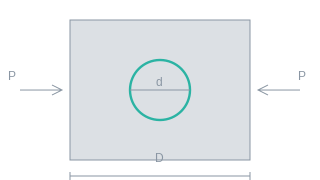
For a flat plate with a central hole in tension, Kt = 3.000 − 3.140 (d / D) + 3.667 (d / D)² − 1.527 (d / D)³, for d / D from 0 up to 1, with the nominal stress on the net section, P / ((D − d) t). Worked example: a plate 50 wide with a 10 hole, 5 thick, under 10 kN. d / D = 0.2 gives Kt = 2.51, a net-section stress of 50.0 MPa and a peak stress of 125.3 MPa.
From Kt to the fatigue factor Kf
Kt is the theoretical, elastic factor. For fatigue, designers reduce it to Kf = 1 + q (Kt − 1), where q is the material's notch sensitivity, between 0 and 1. So Kf lies between 1 and Kt, and taking Kf equal to Kt is the cautious choice. The fillet radius sets Kt. On the drawing, give a stressed shoulder fillet its own radius with limits or a minimum (R3 MIN, for example) rather than leaving it to the general tolerance. A radius made smaller than intended raises the stress. See the fatigue safety factor calculator and the shaft diameter calculator.
Cases this tool leaves out
Tension at a groove, flat-bottomed grooves such as retaining ring grooves, keyways, threads, press-fitted hubs, cross holes and plate cases beyond the central hole in tension. These are curve fits to published charts for ideal shapes in elastic material. Published fits for the same shoulder differ by a few percent. The true peak stress depends on the radius as made: a smaller radius gives a higher factor. Where a failure could hurt someone, the stress is checked by a qualified engineer. For the section properties of a shaft or plate see the section properties calculator, and for ring grooves the retaining ring groove lookup.
Rapid Datum makes the drawing from your STEP file. First drawing free.
Questions
What is a stress concentration factor?
The ratio of the peak stress at a shoulder, groove or hole to the nominal stress there. For a plate 50 wide with a 10 hole, Kt is 2.51.
Does Kt multiply the stress on the whole shaft?
No. It multiplies the nominal stress at the feature: on the small diameter for a shoulder fillet, on the net section beside the hole for a plate.
Should I use Kt or Kf for fatigue?
Kf = 1 + q (Kt − 1) is the fatigue factor, between 1 and Kt. Taking Kf equal to Kt is the cautious choice.