Fatigue safety factor calculator
You have the highest and lowest stress at a point on a part that is loaded over and over, and you want the safety factor against fatigue, with the diagram that shows where the load point sits. It loads with a worked example filled in. Every material value is yours to type: the tool has no presets and does not estimate the endurance limit.
More calculators in the Toolbox
Alternating and mean stress
A stress that goes up and down is described by its alternating stress σa = (maximum − minimum) / 2 and its mean stress σm = (maximum + minimum) / 2. The stress ratio R is the minimum divided by the maximum. The alternating and mean stress at the point you are checking are each multiplied by the fatigue stress-concentration factor Kf. For combined bending and torsion, enter the von Mises alternating and mean stresses. A von Mises mean stress is always entered as positive.
The modified Goodman line
For a mean stress of zero or tension, the fatigue safety factor is nf = 1 / (σa / Se + σm / Sut), where Se is the endurance limit of your part and Sut is the ultimate tensile strength. The line from Se on the alternating axis to Sut on the mean axis is the modified Goodman line. It is a common, cautious choice. Other criteria such as Gerber and ASME-elliptic allow more mean stress. The factor assumes the alternating and mean stress grow in proportion if the load grows. If the steady stress stays fixed and only the alternating part grows, the margin is different and smaller to read off the diagram.
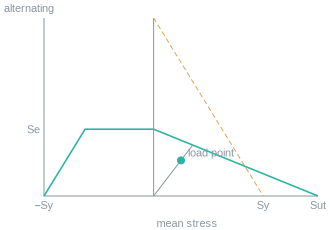
Worked example: maximum 180 MPa and minimum 20 MPa, with Se 150, Sut 600 and Sy 400 (example values, not yours). Then σa = 80 and σm = 100 MPa, R = 0.11, and nf = 1 / (80/150 + 100/600) = 1.43.
The yield check
The part must not yield on the first cycle either. The yield safety factor is ny = Sy / (the larger of the maximum and minimum stress in size), which is Sy / (σa + |σm|). In the example ny = 400 / 180 = 2.22, so fatigue governs. With a maximum of 380 and a minimum of 300, ny = 1.05 is smaller than nf = 1.20: the part yields on the first cycle before fatigue decides.
Compressive mean stress
When the mean stress is compressive, the tool gives it no credit and no penalty: nf = Se / σa. The yield check still applies, with the compressive yield strength taken equal to the tensile one, which is right for the ductile metals this tool is for. On the diagram, the fatigue limit is a horizontal line at Se from σm = 0 out to σm = −(Sy − Se), where it meets the yield line, and the yield line runs on to −Sy on the mean axis.
What goes into the endurance limit
The endurance limit of your part, at its size, surface finish, loading, temperature and reliability, is often well under half the value for a polished test bar. Entering the test-bar value gives a part that is too small. The tool does not estimate it for you.
A safety factor for infinite life at one point on a ductile metal part, for a stress cycle of constant amplitude, from the stresses and strengths you enter. The answer is only as good as the endurance limit, which must be for your part and not a polished test bar, and the stresses, which must include the stress concentration. It leaves out finite-life design, mixed load levels, welds, corrosion, temperature and surface damage. A part whose failure could hurt someone is designed and checked by a qualified engineer.
The modified Goodman method, in the form given in machine design textbooks such as Shigley's Mechanical Engineering Design. For a shaft see the shaft diameter calculator; for deflection, the beam deflection calculator and the compression spring calculator.
Rapid Datum makes the drawing from your STEP file. First drawing free.
Questions
What is a fatigue safety factor?
How many times the load could grow before the part reaches its fatigue limit, if the alternating and mean stress grow in proportion. For a mean stress of zero or tension, nf = 1 / (σa / Se + σm / Sut).
What is the Goodman line?
A straight line on the alternating against mean stress diagram from the endurance limit Se to the ultimate tensile strength Sut. A load point below it has an infinite life by this criterion. It is a common, cautious choice.
Why check yield as well as fatigue?
A load with a high mean stress can yield the part on the first cycle even when the fatigue factor looks fine, so the tool shows both factors and says which is smaller.