Press fit calculator
You are pressing or shrinking a hub, gear, bushing or bearing sleeve onto a shaft. From the fit on the drawing, the tool gives how hard the two parts grip, how much axial force and torque the joint holds before it slips, whether the hub is overstressed at the tightest fit, and how hot the hub must be to drop on. It loads with a worked example filled in. Replace every value marked as an example with your own.
More calculators in the Toolbox
How interference becomes contact pressure
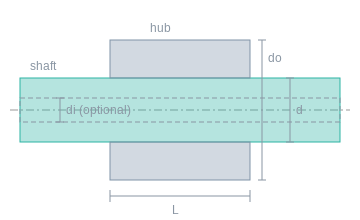
Pressing a shaft that is larger than the bore into a hub squeezes the two together, and the pressure at the joint follows from how much material has to give. For a hub and a solid shaft of the same material, with E the modulus of elasticity:
p = E × interference × (do² − d²) / (2 × d × do²)
For a hub and a shaft of different materials, and a shaft that may be hollow:
p = interference / ( d × [ (1/Eo) × ((do² + d²)/(do² − d²) + νo) + (1/Ei) × ((d² + di²)/(d² − di²) − νi) ] )
Eo and νo are the hub's modulus and Poisson's ratio, Ei and νi the shaft's. This is Lamé's thick-cylinder equations, in the form given in machine design textbooks such as Shigley's Mechanical Engineering Design. The smallest interference of the fit gives the smallest pressure and the largest interference gives the largest, so the tool shows both.
Worked example: a steel hub on a solid steel shaft, Ø25 H7/s6, hub outside diameter 50, length 30, E 200 GPa for both. The hole is 25.000 to 25.021 and the shaft 25.035 to 25.048, so the interference is 0.014 to 0.048. The pressure is 42.0 MPa at the loosest fit and 144.0 MPa at the tightest.
Holding force and torque of a press fit
The force that holds the joint before it slips is F = friction × p × π × d × L, worked from the smallest pressure, and the torque it holds is T = F × d / 2. The friction coefficient decides the result and varies widely, so the tool has no default: type one in. Published ranges for a steel hub on a steel shaft, as listed by Roymech, are 0.07 to 0.16 pressed dry, 0.05 to 0.12 pressed greased, 0.15 to 0.25 shrunk dry and 0.08 to 0.16 shrunk greased. Use the low end when the joint must not slip, and prove a critical joint by test.
In the example with a friction coefficient of 0.12, the holding force is 0.12 × 42.0 × π × 25 × 30 = 11.9 kN and the torque is 148 N·m. The press force at the tightest fit is about 40.7 kN, a rough estimate that varies with lubricant, lead-in chamfer and speed.
Stress in the hub
At the bore of the hub the hoop stress is p × (do² + d²) / (do² − d²), in tension, and the radial stress is −p. The tool combines them as the von Mises equivalent stress, the square root of (hoop² + hoop × p + p²), at the tightest fit, and compares it with the yield strength you enter. In the example the hoop stress is 240 MPa and the equivalent stress 336 MPa. This is the stress at a plain bore: a keyway, cross hole or thin section near the bore raises it. For a cast iron or other brittle hub, compare the hoop stress with the material's tensile strength instead. A hollow shaft also carries hoop stress in compression at its own bore, which the tool shows. Enter the shaft's yield strength to check it too: for a hollow shaft the tool compares the size of that bore stress with it (the radial stress is zero there, so it is the equivalent stress), and for a solid shaft it compares the contact pressure with it.
For a steel hub, a hub five times the bore gives within about 5% of the pressure of a much larger one.
Shrink fit assembly temperature
To drop the hub on, heat it so the bore grows by the largest interference plus the clearance your shop needs. The rise above the shaft is (largest interference + clearance) ÷ (expansion coefficient × d). In the example, with 0.020 of clearance and 12 × 10⁻⁶ per °C, (0.048 + 0.020) / (12 × 10⁻⁶ × 25) is a rise of 227 °C. Cooling the shaft by the same amount does the same job. Heating a hardened or tempered hub can soften it. Check the material's tempering temperature before you heat it, and never heat it past that.
Which ISO fits are press fits
The tool offers the four hole-basis fits meant to interfere: H7/p6, H7/r6, H7/s6 and H7/u6, in that order of increasing grip. It reads their limits for your diameter from the same ISO 286 data as the ISO 286 fit calculator. The transition fits k6, m6 and n6 are left out because they can have no interference at their loosest. At the smallest sizes even H7/p6 has no interference at its loosest, and the tool says so. If your interference comes from somewhere else, enter it, which is also the way to work in inches.
The tool is elastic only, and a first check: it leaves out speed, running temperature, bending, fatigue and fretting. Rough surfaces flatten when pressed, so the real interference is less than the drawn one. DIN 7190-1:2017 takes the loss as about 0.4 × (Rz of the shaft + Rz of the bore), about 2 to 4 µm for a ground shaft in a reamed bore (the 2001 edition used 0.8, which gives less grip). H7/p6 has only a few micrometres of smallest interference, so there it can take all of it. Enter Rz for both surfaces and the tool subtracts it from the smallest interference, which sets the holding force and torque; the stresses and the press force at the largest interference stay as drawn. A joint that carries people or a safety load is designed and checked by a qualified engineer.
To check the size limits of other features, use the ISO 2768 lookup, and the tolerance stack-up calculator adds up a chain of dimensions. The ISO fits guide explains the fit letters and numbers.
Rapid Datum prints each fit with its limits on the drawing it makes from your STEP file. First drawing free.
Questions
How do you calculate the contact pressure of a press fit?
For a hub and solid shaft of the same material, p = E × interference × (do² − d²) / (2 × d × do²), where interference is the diametral interference and do and d are the hub outside and shaft diameters. Different materials and a hollow shaft use Lamé's longer form, which the tool works out.
How much force does a press fit hold?
The holding force before slip is the friction coefficient × the contact pressure × π × d × L, taken at the smallest interference, and the torque is that force × d / 2. The friction coefficient varies widely, so prove a joint that must not slip by test.
How hot does a hub have to be for a shrink fit?
The hub's rise in temperature above the shaft is (largest interference + clearance wanted) ÷ (expansion coefficient × d). Check the material's tempering temperature first, because heating a hardened or tempered hub can soften it.